
Have you ever heard of Fukui? For many travelers, it might be an entirely unfamiliar name. But look at the map — Fukui sits right between Kyoto, Japan’s celebrated ancient capital, and Kanazawa, the city of samurai culture that has been capturing attention in recent years.
Tucked between two towering landmarks, Fukui remains quietly under the radar. Why not take a small detour and discover it for yourself? Whether you’re coming from Kyoto or Kanazawa, the journey is short — and because the crowds haven’t arrived yet, that’s exactly your opportunity.
The prefectural capital is Fukui City, and Hokuriku Shinkansen was extended to Tsuruga in 2024. So the access from Tokyo has been easier.
For the sake of clarity, Fukui Prefecture is roughly divided into four regions.
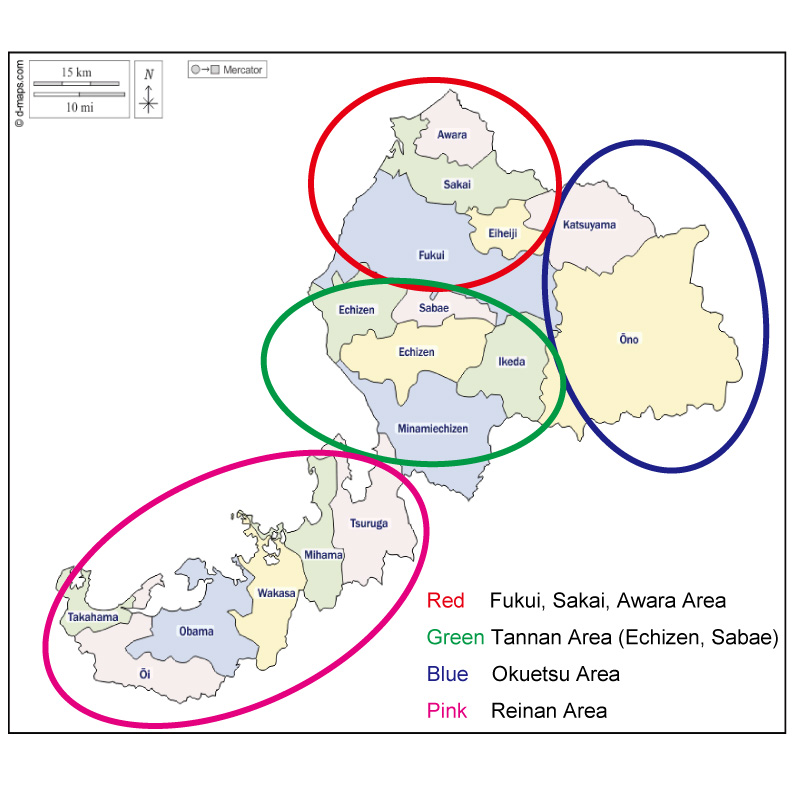
Each has its own distinct character, from the rugged spiritual mountains to the artisanal villages.
Red circle: City area and Zen spirit
Green circle: Centuries of craftsmanship
Blue circle: The Dinosaur Kingdom
Pink circle: Clear lakes and ancient port history
This section introduces Fukui Prefecture with a spotlight on each of these areas.
Red: Fukui, Sakai, Awara and Eiheiji Area
Daihonzan Eiheiji Temple (Eiheiji Town) / One of Japan’s most important Zen temples, set in a quiet cedar forest
Tojinbo (Sakai City) / Rugged basalt cliffs overlooking the Sea of Japan
Ichijodani Asakura Clan Ruins (Fukui City) / A glimpse into a prosperous 16th-century castle town
Yokokan Garden (Fukui City) / A peaceful traditional garden once enjoyed by the ruling family of Fukui
Awara Hot Spring (Awara City) / A relaxed hot spring area with traditional inns and local charm
Maruoka Castle (Sakai City) / One of Japan’s oldest surviving castle keeps
Green: Tannan Area
Echizen Washi Village (Echizen City) / Traditional Japanese papermaking with a history of over 1,500 years
Takefu Knife Village and other Echizen Uchihamono (Echizen City) / Skilled craftsmanship and a long tradition of blade-making
Nishiyama Park (Sabae City) / A favorite spring spot filled with azalea blooms
Echizen Coast/ Rocky shores, open sea views, and one of Fukui’s best coastal drives
Blue: Okuetsu Area
Fukui Prefectural Dinosaur Museum (Katsuyama City) / One of Japan’s best-known dinosaur museums, enjoyed by all ages
Heisenji Hakusan Shrine (Katsuyama City) / Moss-covered grounds and a quietly historic atmosphere
Echizen Ono (Ono City) / A castle town known for clear spring water and traditional streets
Pink: Reinan Area
Tsuruga Museum (Tsuruga City) / The story of Jewish refugees remembered through the port town of Tsuruga
Kehi Shrine (Tsuruga City) / A historic shrine famous for its large wooden torii gate
Myotsuji Temple, Jinguji Temple and national treasures (Obama City) / Historic temples and cultural treasures in a quiet coastal city
Mikatagoko Rainbow Line (Mihama Town, Wakasa Town)/ Panoramic views of the Five Lakes of Mikata and Lake Suigetsu’s annual sediment layers
Detailed explanations are provided in the links.
Food & Local Cuisine
Local Sweets & Souvenirs
Accommodation Areas
The Fukui Station area : Easy access to transportation and sightseeing
Awara Onsen : A major hot spring stay with a range of ryokan and hotels
The Mikuni and Tojinbo area : Coastal scenery, sea views, and memorable sunsets
Official accommodation information
Discover Fukui
Local Industries & Craftsmanship
Sabae eyeglass frames : Widely known for quality and precision
Echizen lacquerware : A traditional craft valued for durability and daily use
Official industry and craft information
Discover Fukui
.
We have not fully introduced all the attractions yet, so we will be adding more content as we go!
“We are more than just interpreters.”
We are a group of passionate locals who love Fukui. We believe that the best travel memories come from deep conversations and hidden stories that you won’t find in a guidebook.
Whether you need a full-day guide or just a few tips on how to get around, we are here to help you make your “small detour” to Fukui unforgettable.
This page includes external links to official tourism websites for informational purposes. All content and images on linked pages remain the property of their respective owners.